Tesla New Flying Car:7 Shocking Facts About Tesla’s New Roadster
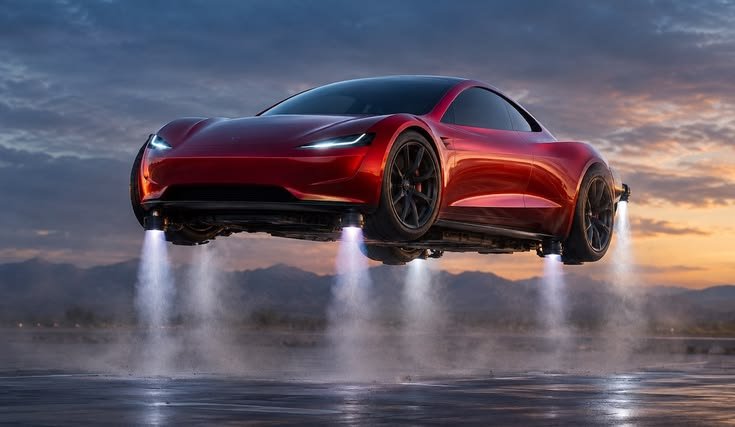
The futuristic exterior design of the 2026 Tesla Roadster.
The Tesla flying car has captured the attention of car enthusiasts who want to see what the future of transportation might look like. Tesla’s next-generation Roadster combines electric-car technology with an ambitious design and optional SpaceX-inspired thrusters. These features have raised an exciting question: could a sports car one day move beyond ordinary roads?
Tesla developed the Roadster to deliver impressive acceleration, a futuristic exterior, and advanced performance technology. In addition, the company has explored specialized systems that could help the vehicle perform brief airborne movements. However, drivers should understand that a short airborne maneuver does not make a car capable of flying like an airplane.
The new Roadster also raises questions about price, driving range, production, and road legality. Although Tesla has shared ambitious targets, buyers still need confirmed production specifications and independent test results.
In this article, we explore seven fascinating features of the Tesla flying car, explain its technology, and examine what buyers should know before getting excited about this futuristic electric sports car.
What Is the Tesla New Flying Car?
The Tesla flying car refers to the next-generation Tesla Roadster and its optional aerospace-inspired thruster technology. Tesla designed the Roadster as an electric sports car, while its specialized thruster system introduces the possibility of brief airborne movements.
Unlike a conventional aircraft, the Roadster does not rely on wings or helicopter-style rotors for sustained flight. Instead, the proposed thruster system uses compressed gas to generate short bursts of force. This technology could help a specially equipped vehicle move upward or change its movement briefly.
Tesla has presented different Roadster configurations, including Performance, Thrust, and Rocket versions. Each configuration targets different performance goals and equipment requirements.
The Performance version focuses on sports-car driving. The Thrust configuration adds specialized technology, while the Rocket version explores the most ambitious aerospace-inspired features.
However, Tesla’s concept needs a clear explanation. A vehicle that briefly leaves the ground does not automatically become a practical flying car. The company must demonstrate how its technology performs under real-world conditions before buyers can judge its everyday usefulness.
1. Tesla New Flying Car Design Looks Futuristic
Tesla has designed the next-generation Roadster with a low profile, smooth bodywork, and a streamlined shape. These features give the vehicle a futuristic appearance while supporting its performance goals.
The front end creates a sleek look, while the sloping roof and sculpted sides give the car the proportions of a high-performance sports car. Meanwhile, the rear design adds another distinctive element to its overall appearance.
Tesla also emphasizes simple styling. Instead of covering the body with unnecessary decorative features, the company uses smooth surfaces and carefully integrated components.
Aerodynamics play an important role in high-performance vehicles. As a car travels faster, air resistance increases and forces the powertrain to work harder. Therefore, engineers must manage airflow around the body to improve stability and efficiency.
Tesla’s active aerodynamic technology can help adjust airflow according to driving conditions. However, the final production specifications will determine exactly how the system works.
The Roadster aims to attract drivers who want supercar performance with electric propulsion. Nevertheless, buyers should check Tesla’s latest announcements because the company may change certain design details before production.
2. SpaceX-Inspired Thrusters Make the Tesla New Flying Car Different
The optional thruster system gives the Tesla Roadster a feature that most electric sports cars do not offer.
Tesla has explored cold-gas thrusters inspired by aerospace technology. These devices release compressed gas to generate force. Engineers can use that force to influence a vehicle’s movement for a short period.
Conventional cars depend on their tires to transfer power to the road. A thruster system introduces another way to generate force and potentially allows a specially equipped vehicle to perform brief airborne maneuvers.
Tesla’s Rocket configuration focuses on this specialized technology. The concept has attracted attention because it brings aerospace-inspired engineering into the automotive world.
However, the system does not work like a conventional airplane engine. It also does not automatically give the Roadster the ability to fly continuously over long distances.
Tesla must demonstrate how the thrusters perform under different conditions. Engineers also need to address stability, control, reliability, and safety before buyers can evaluate the system properly.
Furthermore, specialized equipment can increase complexity and maintenance requirements. Buyers should therefore distinguish between an impressive demonstration and a practical production feature.
The technology remains fascinating, but the Roadster’s actual capabilities will depend on the final system Tesla delivers.
3. Tesla Targets Incredible Acceleration
Tesla has built a reputation for fast electric vehicles, and the Roadster aims to push performance even further.
It claimed the specialized Thrust configuration could accelerate from 0 to 60 mph in under one second. If the production vehicle achieves that target under clearly defined testing conditions, it would deliver extraordinary acceleration.
Electric motors can respond quickly to driver inputs and deliver torque almost immediately. This characteristic helps many electric vehicles accelerate rapidly from a standstill.
However, acceleration depends on several factors, including tire grip, road conditions, temperature, vehicle weight, and battery performance. The testing method also matters when manufacturers publish performance figures.
Tesla has also promoted a top-speed target above 230 mph. Buyers should treat that figure as a manufacturer claim until independent testing verifies the production vehicle’s performance.
High-speed driving requires more than a powerful motor. Engineers must manage braking, cooling, tire performance, aerodynamic forces, and vehicle stability.
For example, a car that accelerates quickly still needs effective brakes to slow down safely. Similarly, its tires must handle the forces that arise during acceleration and cornering.
Therefore, the Roadster’s real-world performance will depend on the complete engineering package rather than one headline number.
4. Electric Power Supports the Tesla Flying Car Concept
The Tesla Roadster uses an electric powertrain instead of a conventional petrol engine. This choice supports Tesla’s focus on rapid acceleration and modern vehicle technology.
Electric motors can deliver power quickly, operate quietly, and reduce the need for traditional multi-speed gear changes in many vehicle designs. Electric vehicles also produce no tailpipe exhaust while driving, although battery manufacturing and electricity generation still affect their overall environmental impact.
Driving range remains another important consideration.
Tesla previously promoted a range of up to 620 miles for an earlier Roadster concept. However, buyers should not automatically apply that older figure to the redesigned model.
Reports about the next-generation Roadster have discussed a range target above 300 miles. Tesla still needs to confirm the final production specifications and the testing method behind any official range figure.
Real-world driving conditions can change how far an electric car travels on a full charge. For example, high-speed driving generally consumes more energy than steady cruising. Cold weather can also affect battery performance, while frequent acceleration may increase energy use.
Drivers who use climate control and other electrical systems may also see changes in range.
Consequently, buyers should wait for confirmed battery specifications and independent range tests before comparing the Roadster with other electric sports cars.
5. Advanced Aerodynamics Could Improve Grip
Tesla has also explored a fan-based system that aims to create additional downforce.
Downforce pushes a vehicle toward the road and helps its tires maintain contact with the surface. Sports-car manufacturers often use wings, diffusers, and carefully shaped bodywork to generate this force.
Tesla’s proposed approach uses fans to draw air from beneath the vehicle. The company has demonstrated how specialized equipment can create substantial suction under controlled conditions.
This technology attracted attention because it suggests another way to manage grip beyond traditional aerodynamic components.
However, drivers should not assume that the Roadster can drive upside down on ordinary roads or climb walls. Such demonstrations depend on specialized equipment and controlled conditions.
Active aerodynamic systems can also help engineers balance different goals. For example, a vehicle may need more downforce for stability in certain situations, while lower aerodynamic drag can help improve efficiency.
Nevertheless, Tesla must explain how the production system operates, how much energy it consumes, and how it affects maintenance.
The technology could make the Roadster different from a conventional electric supercar. Its practical value, however, will depend on real-world testing.
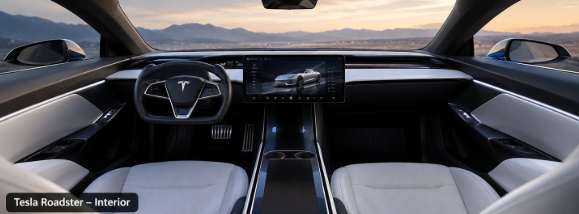
6. The Tesla Roadster Interior Focuses on Technology
Tesla generally favors minimalist interiors, digital displays, and simple controls. The next-generation Roadster aims to combine that design philosophy with a high-performance driving experience.
A sports-car cabin must balance technology with practicality. Drivers need clear information, comfortable seating, useful controls, and good visibility. A futuristic dashboard cannot replace these essential features.
Tesla has described different seating arrangements for its Roadster configurations. The Performance and Thrust versions feature two seats, while the Rocket configuration uses a single-seat layout.
This difference reflects the specialized nature of the Rocket version. Its additional equipment changes the cabin arrangement and makes it less suitable for drivers who regularly carry passengers.
Tesla still needs to confirm the final production interior, including its display layout, storage space, comfort features, and available driver-assistance systems.
Buyers should also distinguish between features the company has confirmed and details that remain unknown.
A well-designed interior should help drivers understand important vehicle information without unnecessary distractions. Therefore, the final controls and displays will play an important role in the Roadster’s usability.
Although futuristic styling attracts attention, Tesla must also deliver comfort, visibility, and sensible ergonomics.
7. Tesla Flying Car Price and Release Date
The Tesla Roadster’s price remains one of the biggest questions for potential buyers.
Tesla has not confirmed a final retail price for every configuration. Reports have discussed reservation deposits of $50,000 for the Performance version and $250,000 for the Thrust version. However, buyers should not confuse these deposits with the complete purchase price.
A reservation deposit represents an initial payment under specific terms. It does not automatically tell buyers how much they will eventually pay for the vehicle.
The Rocket version introduces further uncertainty because Tesla describes it as an invitation-only configuration. Buyers need official details about its final price, availability, and purchase conditions.
The release timeline also deserves attention.
Tesla has announced a planned production start in 2028. However, a planned production date does not guarantee that the company will deliver vehicles on that exact schedule.
The original next-generation Roadster announcement dates back to 2017, and the project has experienced delays. Therefore, buyers should treat the production date as a target rather than a guaranteed delivery deadline.
Before placing a reservation, interested customers should review Tesla’s official terms and wait for confirmed pricing, specifications, warranty information, and delivery details.
Tesla Flying Car Specifications
The following table summarizes the main announced details and highlights information that still needs confirmation.
| Specification | Details |
|---|---|
| Vehicle type | High-performance electric sports car |
| Manufacturer | Tesla |
| Powertrain | Electric |
| Special technology | Optional SpaceX-inspired thrusters |
| Configurations | Performance, Thrust, Rocket |
| Claimed acceleration | Under one second from 0–60 mph for Thrust |
| Claimed top speed | More than 230 mph |
| Driving range | Final production figure requires confirmation |
| Seating | Two seats for Performance and Thrust; one for Rocket |
| Rocket configuration | Invitation-only |
| Rocket public-road status | Tesla says it is not approved for public-road use |
| Planned production | 2028 |
| Final retail price | Not fully confirmed |
Note: Tesla’s announced targets may differ from the final production specifications. Independent tests will help verify actual performance.
Is the Tesla Flying Car Really Capable of Flight?
The answer depends on what someone means by a flying car.
If the term describes a road vehicle that can briefly leave the ground using specialized equipment, the Roadster’s thruster concept fits that description.
However, a vehicle that briefly rises into the air does not automatically become an aircraft. Conventional aircraft use carefully engineered systems to generate lift, maintain stability, and control sustained flight.
Tesla has not demonstrated that the Roadster can fly over long distances like an airplane or operate as a conventional air taxi.
This distinction matters because exciting demonstrations can create unrealistic expectations. A brief airborne movement does not prove that a vehicle can transport passengers through the air safely in everyday conditions.
Tesla must demonstrate the technology’s practical limits and explain how the specialized system handles different operating conditions.
The Rocket configuration also comes with an important restriction: Tesla states that it is not approved for public-road use. Drivers should not assume they can legally use every special feature on ordinary streets.
For now, the Roadster is best understood as an electric sports car with an ambitious aerospace-inspired concept rather than a replacement for aircraft.
Safety Challenges Tesla Must Address
The Tesla flying car concept raises several important safety questions.
First, Tesla must demonstrate reliable control during any airborne maneuver. Engineers need to ensure that the vehicle remains stable and returns safely to the ground.
Second, the company must consider component failures. Specialized propulsion and active aerodynamic systems introduce additional parts that require careful testing and maintenance.
Third, engineers must evaluate how the equipment affects vehicle weight, energy consumption, durability, and passenger protection.
Finally, Tesla must explain the legal restrictions that apply to each configuration. Vehicle regulations vary by jurisdiction, and the Rocket version’s stated road-use restriction makes this issue especially important.
Independent testing, production validation, and clear safety documentation will help buyers understand the vehicle’s capabilities.
These challenges do not make the technology less interesting. Instead, they show why Tesla must prove its claims before buyers can judge the Roadster as a complete production vehicle.
How the Tesla Flying Car Could Influence Future Vehicles
The Tesla Roadster could influence automotive engineering even if the company produces it in relatively small numbers.
Its electric powertrain reflects the wider shift toward battery-powered vehicles. Meanwhile, its active aerodynamic systems demonstrate how manufacturers can use fans and adjustable components to manage airflow and grip.
The optional thrusters also explore a connection between aerospace engineering and automotive design.
However, conventional family cars will not necessarily adopt rocket-style thrusters. Manufacturers must consider cost, reliability, energy use, safety, and regulations before introducing experimental systems into everyday vehicles.
The Roadster may therefore serve as a technology showcase rather than a blueprint for every future car.
Its most important contribution could be encouraging engineers to explore new approaches to performance while highlighting the practical challenges they must overcome.
If Tesla delivers a reliable production vehicle, the Roadster could become an interesting example of how electric propulsion and advanced vehicle systems can work together.
Frequently Asked Questions
1. What is the Tesla flying car called?
The Tesla flying car concept centers on the next-generation Tesla Roadster and its specialized Rocket configuration with SpaceX-inspired thruster technology.
2. Can the Tesla Roadster actually fly?
Tesla has explored brief airborne movements using specialized thrusters. The vehicle has not demonstrated sustained flight like a conventional aircraft.
3. When will Tesla release the new Roadster?
Tesla has announced a planned production start in 2028. The company could change that timeline, so buyers should check its official updates.
4. How fast is the Tesla flying car?
Tesla claims that the Thrust configuration can accelerate from zero to 60 mph in under one second. Independent testing must verify the production vehicle’s actual performance.
5. How much will the Tesla Roadster cost?
Tesla has not fully confirmed the final retail price of every configuration. Reported reservation deposits do not represent the complete purchase price.
6. Is the Tesla Rocket Roadster street legal?
Tesla states that the Rocket configuration is not approved for public-road use. Buyers should check official documentation and applicable regulations.
7. Does the Tesla Roadster use petrol?
No. The Roadster uses an electric powertrain rather than a conventional petrol engine.
8. How far can the Tesla Roadster travel on one charge?
The final production range requires confirmation. Buyers should not automatically apply older concept figures to the redesigned vehicle.
Final Verdict
The Tesla flying car concept combines electric performance, futuristic styling, advanced aerodynamics, and SpaceX-inspired thrusters. Together, these features make the next-generation Roadster an unusual sports-car project.
However, buyers should separate Tesla’s ambitious claims from confirmed production results. The final price, driving range, independent performance figures, and delivery schedule remain important questions.
Tesla’s planned 2028 production target gives the company time to develop the vehicle further. Whether the Roadster changes automotive engineering or remains a specialized technology showcase will depend on the finished product.
For now, the Roadster offers a fascinating look at the possibilities of electric-car engineering. Its greatest test will come when Tesla delivers production vehicles and independent testers measure what the car can actually do.
Tesla flying car, Tesla Roadster, new Tesla Roadster, flying electric car, Tesla Roadster 2026, SpaceX thrusters, Tesla car news, electric supercar, Tesla flying car price, Tesla Roadster release date, future cars, futuristic electric cars, Tesla performance car, cold gas thrusters, Tesla Rocket version, electric sports cars, next generation Tesla, Tesla technology, flying car technology, CarsGallery
#TeslaFlyingCar #TeslaRoadster #NewTeslaRoadster #FlyingCar #ElectricSupercar #TeslaNews #SpaceXTechnology #FutureCars #ElectricCars #TeslaPerformance #Roadster2026 #FlyingElectricCar #CarTechnology #FutureOfMobility #ColdGasThrusters #TeslaRocket #SupercarNews #AutomotiveInnovation #ElectricVehicle #CarsGallery