How Fast Do F1 Cars Go? Surprising Top Speed Facts
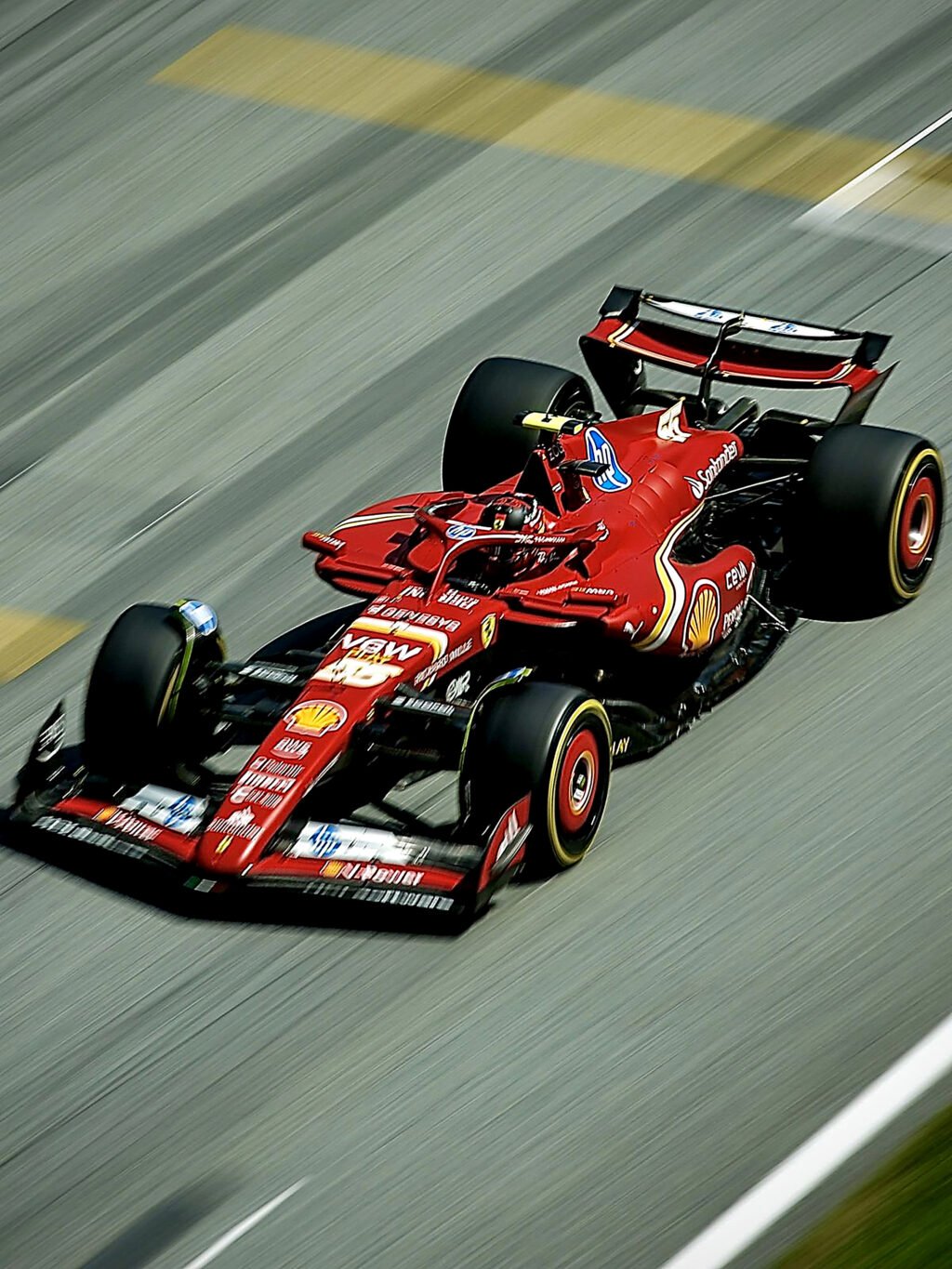
On the quickest tracks, F1 cars pass 330 km/h.
How fast do F1 cars go? Faster than almost anything else you will ever see on a race track. On the quickest circuits, Formula 1 cars pass 330 km/h (about 205 mph). In rare cases, they go even higher.
But top speed is only one part of the story. An F1 car also accelerates, brakes and corners in ways that no road car can match. That is why lap times are so short. In this guide, you will learn the real numbers, the records and the reasons behind them.
Let’s start with what happens in a real race.
How Fast Do F1 Cars Go in a Real Race?
In a race, the top speed depends on the track. On the fastest circuits, drivers usually reach somewhere between 320 and 360 km/h (about 200 to 224 mph). On twisty street circuits, they never get close to that.
Why is the gap so big? It comes down to straights. A long straight gives the car time to build speed. A short straight does not. Therefore, the same car can look very different from one weekend to the next.
Teams also choose a wing setting for each race. Some tracks need more grip. Others need less drag. As a result, a car set up for Monaco is much slower in a straight line than one set up for Monza.
Keep one thing in mind. Speed trap figures and onboard data can differ. Slipstream, wind and engine mode all change the number. So treat any single figure as a snapshot, not a rule.
How Fast Do F1 Cars Go at Their Absolute Limit?
Two numbers come up again and again when fans talk about records. They come from very different situations, so let’s separate them.
The fastest speed in an official race weekend
The figure most often quoted is 372.5 km/h (231.4 mph). Valtteri Bottas set it in a Williams at the 2016 Azerbaijan Grand Prix in Baku. The track has a main straight of about 2.2 km. Add a strong slipstream, and the car simply keeps pulling.
Other unofficial claims exist from different sessions. However, the Baku number is the one most people treat as the benchmark. Always check the source before you repeat a speed.
The fastest speed in a special test
In 2006, Honda took a modified RA106 car to the Bonneville Salt Flats in the United States. It reached 397.36 km/h (246.9 mph). Honda stated that this was not an official record.
The car ran in a special low-drag setup on a very long, flat surface. Therefore, it is a fun fact, but it is not a race number.
How Fast Do F1 Cars Go Compared to Road Cars?
In a straight line, some road cars are faster. The Bugatti Chiron Super Sport 300+ reached 490.48 km/h (304.77 mph) in a one-way run in 2019. That is far above any F1 car’s top speed.
Still, an F1 car would beat that Bugatti around almost any race track. Why? Because lap time depends on much more than top speed. Here is what matters.
- Acceleration: An F1 car goes from 0 to 100 km/h in roughly 2.6 seconds. Many fast road cars need longer.
- Cornering: Drivers feel around 5G or more in fast corners. That is five times their body weight.
- Braking: The car can slow down from very high speeds over a short distance. Braking forces can also reach about 5G.
- Grip: Wings and tyres keep the car glued to the track.
For a simple comparison, think about a motorway. The speed limit in many countries is around 120 km/h. At 330 km/h, an F1 car travels nearly three times faster than that.
What Makes F1 Cars So Fast?
No single part makes an F1 car quick. Instead, many systems work together. Let’s look at the main ones.
The hybrid power unit
From 2014, F1 used a 1.6-litre V6 turbo hybrid power unit. The engine could rev up to 15,000 rpm. An electric motor added extra power on top. Together, they produced more than 1,000 horsepower.
The 2026 rules keep a V6 turbo engine. However, they give the electric side a much bigger role. Because rules change often, it is smart to check the latest regulations before you quote exact power figures.
Aerodynamics and downforce
Wings, the floor and the diffuser push the car down onto the track. This force is called downforce. It works like an invisible hand pressing the car into the road.
At high speed, downforce can be larger than the weight of the car. For this reason, people often say an F1 car could drive upside down in a tunnel. That is a theory, not something teams test. Still, it shows how strong the effect is.
Low weight
F1 cars are very light. In recent seasons, the minimum weight was just under 800 kg including the driver. A typical family car is far heavier. Less weight means faster acceleration, quicker braking and sharper turns. The newer 2026 cars are also smaller and lighter.
Tyres
Pirelli supplies the tyres for every team. Softer tyres give more grip but wear out faster. Harder tyres last longer but give less grip. Drivers and teams must find the right balance. In addition, tyres need the right temperature to work well.
Why F1 Top Speed Changes From Track to Track
Not every circuit lets a car stretch its legs. Here are three famous examples.
Monza: the Temple of Speed
Monza in Italy is known as the fastest track on the calendar. It has long straights and only a few slow corners. Teams run low-downforce wings there to cut drag. In recent years, pole laps at Monza have averaged over 260 km/h. That is the fastest lap speed in the sport.
Monaco: slow but demanding
Monaco is the opposite. The streets are narrow, and the corners are tight. A qualifying lap there averages closer to 170 km/h. Teams use maximum downforce. As a result, top speed is low, but the driver skill needed is huge.
Baku: the long straight
Baku mixes a slow old town section with a very long straight. That straight helps cars reach some of the highest speeds of the season. Meanwhile, the castle section is tight and slow. It is a good example of how one track can ask for two different car setups.
DRS, Slipstream and Overtaking
Two tricks help cars go even faster on a straight.
The first is the slipstream. When a car follows another closely, it sits in the air that the leader pushes aside. There is less drag, so the car behind gains speed. Drivers call this the tow.
The second is the Drag Reduction System, or DRS. A flap on the rear wing opens in set zones. It cuts drag and adds speed. A driver could use it when within one second of the car ahead.
However, the sport is changing. The 2026 rules replace DRS with moveable aerodynamics and a new overtaking mode. The goal is the same: help cars pass each other more easily. The details may change, so check the official F1 website for the latest rules.
Cornering and Braking: Where F1 Cars Really Win
Top speed gets the headlines. Yet most lap time is won or lost in the corners.
In fast corners, downforce lets the car turn at speeds that would throw a road car off the track. The driver’s body feels forces of 5G or more. That is why F1 drivers train their necks and core muscles so hard.
Braking is just as dramatic. Cars arrive at the end of a straight at over 300 km/h. Then they slow for the corner in a very short distance. In fact, many fans find the braking zones more impressive than the straights.
How Do Drivers Handle Such High Speeds?
It takes years of training. Drivers build strength, stamina and fast reactions. They also work with engineers to learn every detail of the car and the track.
Safety has improved a lot too. The cockpit is a strong survival cell. Since 2018, every car has also used the halo, a protective bar above the driver’s head. Crash structures absorb energy, and the helmets and suits are built to a high standard. Because of this, drivers walk away from crashes that would have been far worse in the past.
Quick F1 Speed Facts
- Typical top speeds on fast tracks: about 320 to 360 km/h.
- Most quoted official race-weekend top speed: 372.5 km/h, set in 2016 in Baku.
- Honda’s 2006 test run reached 397.36 km/h, but it was not an official record.
- 0 to 100 km/h takes roughly 2.6 seconds.
- Drivers face about 5G or more in corners and under braking.
- Pit lane speed limits are usually 80 km/h, and lower at some tracks.
Frequently Asked Questions About How Fast Do F1 Cars Go?
What is the top speed of an F1 car?
In a normal race, the top speed is usually between 320 and 360 km/h, depending on the track and setup. The most quoted official number from a race weekend is 372.5 km/h.
Is an F1 car faster than a Bugatti?
Not in a straight line. The Bugatti Chiron Super Sport 300+ went past 490 km/h in a one-way run. However, an F1 car is much quicker around a race track because of its grip, braking and cornering.
How fast is an F1 car from 0 to 100 km/h?
It takes roughly 2.6 seconds. Exact times vary with the car, the track surface and the conditions.
Which F1 track is the fastest?
Monza in Italy is widely seen as the fastest track. Its long straights and quick corners give it the highest average lap speeds.
Why is there a speed limit in the pit lane?
Mechanics work close to the cars. A limit, usually 80 km/h, keeps them and the drivers safe. Some tracks use a lower limit.
Final Thoughts About How Fast Do F1 Cars Go?
So, how fast do F1 cars go? On the quickest tracks, they pass 330 km/h, and the record from a race weekend is around 372.5 km/h. Still, the real magic is not top speed. It is the mix of acceleration, grip, braking and cornering.
That mix is why an F1 car can beat nearly any road car around a track. And with new rules arriving in 2026, the cars will keep changing. Check back often for the latest speed facts.
#F1 #Formula1 #F1Cars #HowFastDoF1CarsGo #F1Facts #F1TopSpeed #Monza #SpeedFacts #MotorSport #Racing #FastestCars #SportsCars #F1News #CarFacts #CarsGallery
F1 cars, Formula 1, F1 top speed, how fast do F1 cars go, fastest F1 car, F1 speed record, F1 facts, F1 acceleration, Monza, F1 vs Bugatti